The routeWritten as you'd travel it independently — where each day goes and what there is to do when you get there, following the same stops and activities G Adventures runs wherever you could arrange them yourself.
DIY Reality CheckWhere doing it yourself gets hard: permits, closures, bookings that sell out months ahead.
G Adventures includesBooked start to finish as one 16-day trip — you can't buy a single day of it. These panels show what their price covers each day, so you can weigh it against doing it yourself.
What It Takes to Coordinate This Route Yourself
Driving 1,403 km of the 1,526 km total distance is straightforward; a traveller could rent an ordinary car and drive this themselves, as no specialist off-road vehicle is required. The complexity lies in sequencing 18 transport legs, which include five scheduled public transport connections booked as ordinary tickets. Over 16 days, this self-arranged journey requires coordinating 15 nights of accommodation across eight properties. Stays span nine separate stops: three are single nights, six run longer, and the longest is a two-night stay early on. Booking 22 activities and managing six days with threaded transfer stops is the logistical friction a coordinated route eliminates.
Day 10 in Mykonos anchors this route, separating the mainland's classical ruins from the Aegean islands. The preceding overland loop through Delphi and Olympia leads to this 105km ferry crossing. A traveler must coordinate this specific marine transit to connect with the subsequent morning ferries to Naxos and Santorini.
The volcanic ruins of Akrotiri, a Minoan Bronze Age settlement, culminate a historical survey that first winds past the suspended monasteries of Meteora and the classical healing sanctuary of Epidaurus.
The Route, Day by Day
Day1
Athens
Arrival in Athens
Day 1 of 16
Arrive in Athens at any time. The capital of Greece is a sprawling, modern metropolis built around its ancient core, where millennia of history are layered visibly on the urban landscape. Make your way to your accommodation and settle in before a first exploratory walk through the surrounding neighbourhood.
📍On the ground
Arrive at any time and make your way to the hotel.
Where you stay: International Atene Hotel
Day2
Athens
The Acropolis & Ancient Agora
Day 2 of 16
After a morning at leisure, the day's focus shifts to the foundational sites of Western thought. Following lunch at Shedia Home, a non-profit cafe addressing homelessness in Athens, the afternoon is dedicated to an archaeological exploration of the Acropolis. The visit centers on the Parthenon, a Doric temple dedicated to the goddess Athena, constructed from Pentelic marble and completed in 438 BC after nearly a decade of work. The route continues down to the Ancient Agora, the sprawling marketplace that once served as the city's commercial, political, and social hub. Here, among the foundations of stoas and administrative buildings, figures like Socrates and Plato developed the philosophical frameworks that would define the classical world. The on-site museum, housed in the reconstructed Stoa of Attalos, provides essential context.
📍On the ground
Guided tour of the Acropolis and Ancient Agora with an archaeologist.
Visit the Parthenon, a temple to Athena completed in the 5th century BC.
Lunch at Shedia Home, a non-profit cafe supporting Athens' homeless community.
Where you stay: International Atene Hotel
Day3
Athens to Kalampáka
Thermopylae & Truffle Hunting
Day 3 of 16
The route turns north today, tracing an overland path from Athens toward the plains of Thessaly. A key stop is made at Thermopylae, the narrow coastal pass where a small force of Spartans and their allies, led by King Leonidas, held off the invading Persian army in 480 BC. A modern monument marks the battlefield. The day's destination is Kalampáka, the town at the foot of the Meteora rock formations.
The afternoon offers a distinct shift in focus from the historical to the mycological. A local truffle hunter and his trained dogs lead an excursion into the surrounding forests to forage for the prized subterranean fungi. The experience concludes with a tasting and a truffle-based dinner, grounding the day's travel in the region's specific terroir.
📍On the ground
Overland journey from Athens to Kalampáka (approx. 345km).
Stop at Thermopylae, site of the famous 480 BC battle.
Join a local hunter and his dogs for a truffle-hunting excursion.
The morning is dedicated to exploring the monasteries of Meteora, a UNESCO World Heritage site. These Eastern Orthodox monastic communities were built from the 14th century onward atop immense natural sandstone pillars, some rising over 300 meters from the valley floor. This precarious placement provided sanctuary and isolation during the turbulent final centuries of the Byzantine Empire. A guided visit explores two of the six remaining active monasteries, examining the post-Byzantine frescoes that adorn their chapels and the panoramic views over the Plain of Thessaly.
In the afternoon, the journey continues south to Delphi. The road climbs through the mountains of Central Greece, arriving at the town perched on the slopes of Mount Parnassus, site of the most important oracle in the classical Greek world.
📍On the ground
Explore 14th-century chapels built atop towering sandstone pillars.
The day begins at the Panhellenic sanctuary of Delphi, which the ancient Greeks considered the omphalos, or navel, of the world. A guided tour of the archaeological site traces the Sacred Way past the treasuries of various city-states to the Temple of Apollo, where the Pythia, or Oracle, would deliver her prophecies. The visit includes the well-preserved theatre and the stadium, which hosted the Pythian Games. The adjacent Archaeological Museum of Delphi houses key artifacts unearthed from the site, including the bronze Charioteer of Delphi.
Later, the route crosses the Gulf of Corinth via the Rio-Antirrio Bridge, a significant work of modern engineering, to enter the Peloponnese peninsula. The final leg of the journey leads to Olympia, the ancient sanctuary that gave its name to the Olympic Games.
📍On the ground
Explore the ruins of the Temple of Apollo, seat of the fabled oracle.
Cross the Gulf of Corinth via the multi-span Rio-Antirrio Bridge.
Overland journey to Olympia (approx. 223km).
Where you stay: Hotel Amalia Olympia
Day6
Olympia to Náfplio
Birthplace of the Olympic Games
Day 6 of 16
Today's exploration focuses on the archaeological site of Olympia, the birthplace of the ancient Olympic Games, first held in 776 BC. The visit encompasses the ruins of the Doric temples of Zeus and Hera, the latter of which serves as the starting point for the modern Olympic torch relay. One can walk through the original stadium, entering through the arched tunnel used by athletes, and stand on the ancient starting line. The nearby Archaeological Museum holds masterpieces of Greek sculpture recovered from the site.
Afterwards, the route continues across the Peloponnese to the seaside city of Náfplio, the first capital of modern Greece. A walking tour of the old town navigates its Venetian-influenced streets, with views of the Palamidi Fortress looming above and the Bourtzi Castle in the harbour.
📍On the ground
Guided visit to the Olympia archaeological site and museum, a UNESCO site.
Stand in the ancient stadium where the first Olympic Games were held in 776 BC.
Overland journey to the seaside city of Náfplio (approx. 214km).
Walking tour of Náfplio's old town with views of Bourtzi Castle.
Where you stay: Hotel Amalia Nafplio
Day7
Náfplio
The Citadel of Mycenae
Day 7 of 16
After a morning at leisure to explore Náfplio's neoclassical architecture and waterfront, the afternoon shifts to the Bronze Age. An excursion leads to the nearby citadel of Mycenae, a UNESCO World Heritage site and the center of the powerful Mycenaean civilization that dominated the Greek world from roughly 1600 to 1100 BC. This is the legendary home of King Agamemnon. The tour enters the fortress through the Lion Gate, a 13th-century BC relief sculpture, and explores the royal graves and massive Cyclopean walls. The day concludes in the Nemea region, known for its Agiorgitiko grapes, with a wine tasting paired with local cheeses and mezze.
📍On the ground
Enter the fortress through the famed Lion Gate, dating to the 13th century BC.
Wine tasting at a regional winery in Nemea, paired with cheese and mezze.
Where you stay: Hotel Amalia Nafplio
Day8
Náfplio to Athens
Epidaurus and the Corinth Canal
Day 8 of 16
The return journey to Athens begins with a significant detour to Epidaurus. This UNESCO-listed site was the most celebrated healing center of the Classical world, dedicated to Asclepius, the god of medicine. The visit includes the ruins of the Asclepieion, a complex of temples and patient dormitories that functioned as an early hospital. The site's primary feature is its magnificent 4th-century BC theatre, renowned for its near-perfect acoustics and still used for performances today.
From Epidaurus, the road heads north, crossing the Isthmus of Corinth. A stop provides a view of the Corinth Canal, a 19th-century engineering feat that slices through 6.4 kilometers of rock to connect the Gulf of Corinth with the Saronic Gulf, effectively making the Peloponnese an island. The final leg of the drive completes the return to Athens.
📍On the ground
Visit the ancient sanctuary of Asclepius at Epidaurus, a UNESCO site.
Explore the well-preserved 4th-century BC theatre of Epidaurus.
Stop at the Corinth Canal, separating the Peloponnese from mainland Greece.
Return journey to Athens — 190km to Epidaurus, 60km on to the Corinth Canal, then 93km into Athens (about 343km total).
Where you stay: International Atene Hotel
Day9
Athens
A Day at Leisure in Athens
Day 9 of 16
This is a full, unstructured day for independent exploration of Athens. Beyond the major classical sites, the city offers a dense fabric of history to investigate. One could visit the Panathenaic Stadium, the all-marble structure that hosted the first modern Olympics in 1896, or the ruins of Hadrian's Library. For a respite from the urban density, the National Garden provides a quiet, shaded network of paths adjacent to the Hellenic Parliament.
📍On the ground
Where you stay: International Atene Hotel
Day10
Athens to Mykonos
Ferry to Mykonos
Day 10 of 16
The focus shifts from the mainland to the Aegean as a morning ferry — about 105km of Aegean crossing — departs for the Cyclades, arriving at the island of Mykonos. Known for its whitewashed, cubist architecture and vibrant energy, the island offers a different facet of Greek life. After settling in, an orientation walk navigates the labyrinthine alleys of Mykonos Town (Chora). The walk leads to the iconic 16th-century windmills on the hill above the town and concludes in the Little Venice quarter, where houses are built directly on the water's edge.
📍On the ground
Ferry crossing from Athens to the island of Mykonos (approx. 2.5h).
Orientation walk through Mykonos Town.
See the iconic windmills and the waterfront of Little Venice.
Following a free morning on Mykonos, a short boat ride of roughly 8km leads to the nearby island of Delos, one of the most significant archaeological sites in Greece. According to mythological tradition, the island is the birthplace of the twin gods Apollo and Artemis; as a result, it developed into a major Panhellenic sanctuary and, later, a thriving commercial port. Today, the entire island is a UNESCO World Heritage site, uninhabited and preserved as an open-air museum. The extensive ruins are open to explore, including the Sacred Harbor, the Terrace of the Lions with its 7th-century BC marble statues, and the ancient temples dedicated to Apollo and Artemis.
📍On the ground
Excursion to the island of Delos, a UNESCO World Heritage site.
Guided tour of the archaeological site with a local archaeologist.
See the Terrace of the Lions and the temples of Apollo and Artemis.
Where you stay: Mykonos Beach Hotel
Day12
Mykonos to Naxos
Naxos and the Portara
Day 12 of 16
A morning ferry continues the island-hopping route to Naxos, the largest and most fertile of the Cycladic islands. Upon arrival, the day offers a culinary introduction to the island's distinct produce and traditions, focusing on a lesson in preparing Naxian Rosto, a slow-cooked pork dish. Later, a walking tour of the main town begins at the Portara, the massive 6th-century BC marble gate of an unfinished temple to Apollo that has become the island's emblem. The walk continues into the Kastro, the Venetian-era citadel, navigating winding alleys to the 11th-century Catholic Cathedral and the former Ursuline School, which houses a historical collection.
📍On the ground
Ferry crossing from Mykonos to Naxos.
Walking tour of Naxos town, including the 6th-century BC Portara.
Learn about sea turtle conservation with the Naxos Wildlife Protection Association.
Culinary lesson on Naxian Rosto, a traditional slow-cooked pork dish.
Today is dedicated to exploring the agricultural heartland of Naxos, a landscape of olive groves, marble quarries, and historic villages. A guided walk (4km to Chálki + 2km onward) links several inland settlements, offering a cross-section of the island's culture. The route passes the Kouroi of Flerio, two colossal, unfinished marble statues from the 6th century BC left in an ancient quarry. In the village of Chalki, a former capital, there's an opportunity to taste Kitron, a local citron-leaf liqueur. The walk continues through olive groves to Kaloxylos, before a visit to the Naxos Wildlife Protection organization to learn about their sea turtle and marine conservation efforts.
📍On the ground
Full-day guided hike through the Naxian countryside.
Visit the ancient Kouroi statues and the watermills of Myloi.
Sample local Kitron liqueur in Chalki and olive oil in Kaloxylos.
Learn about conservation efforts at the Naxos Wildlife Protection organization.
A morning ferry delivers you to Santorini (Thira), the dramatic volcanic island famed for its caldera views. The day's main excursion is to the archaeological site of Akrotiri, a Minoan Bronze Age settlement that was buried by a cataclysmic volcanic eruption in the 16th century BC. Like Pompeii, the volcanic ash preserved the city, providing a remarkable snapshot of life 3,600 years ago, including multi-story buildings and intricate frescoes. Later, there is an opportunity for a walk along a section of the caldera path between Fira and Oia, offering commanding views of the submerged volcano and the island's cliff-clinging villages.
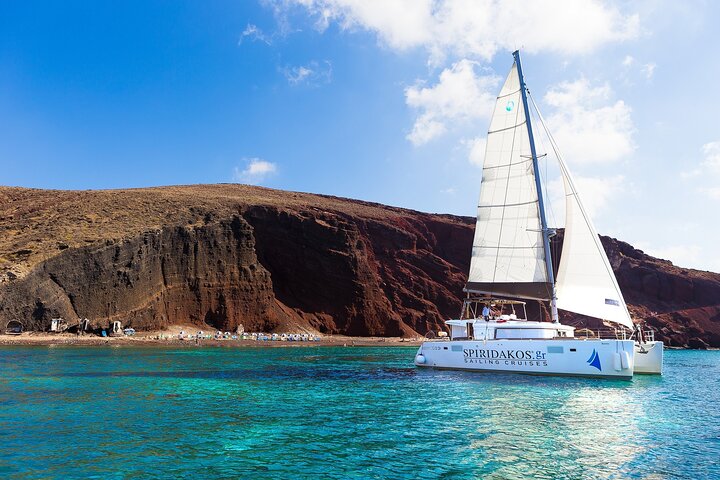
The day is free for independent exploration of Santorini. Options range from relaxing on one of the island's volcanic-sand beaches—like the red beach or black beaches of Perissa and Perivolos—to further exploring the towns of Fira or Oia. A popular activity is a boat excursion into the caldera itself, which typically includes a stop to hike on the volcanic crater of Nea Kameni and swim in the hot springs off the coast of Palea Kameni. The evening presents an opportunity to find a vantage point in Oia to watch the celebrated sunset over the Aegean.
📍On the ground
Optional sailing excursion to the volcanic islands of Palea and Nea Kameni.
Opportunity to watch the sunset from the village of Oia.
Where you stay: De Sol Hotel & Spa Santorini
Day16
Santorini
Departure from Santorini
Day 16 of 16
The journey through classical Greece and its island jewels concludes this morning. There are no planned activities, allowing for departure from Santorini at any time. The island's airport provides connections to Athens and other European cities.
📍On the ground
Depart at any time.
📷 Been to Greece?
Create an account
and share your photos from any day of this route.
Ready to go?
Book Journeys: Classical Greece and Her Island Jewels by G Adventures.
From $6,399 USD · 16 days · Upgraded hotels, ground transport, ferries, and select meals