The routeWritten as you'd travel it independently — where each day goes and what there is to do when you get there, following the same stops and activities G Adventures runs wherever you could arrange them yourself.
DIY Reality CheckWhere doing it yourself gets hard: permits, closures, bookings that sell out months ahead.
G Adventures includesBooked start to finish as one 9-day trip — you can't buy a single day of it. These panels show what their price covers each day, so you can weigh it against doing it yourself.
What It Takes to Coordinate This Route Yourself
A traveller could rent an ordinary car and drive this 246 km route themselves, as every road leg uses a standard private vehicle requiring no specialist or off-road driving. Over nine days, the logistics involve 17 transport legs, including four scheduled public transport legs and two domestic flights booked as ordinary tickets. Across five separate stays, where two are a single night and three run longer, one must arrange eight nights of accommodation across four properties and 17 activities. Six days thread a stop into a city-to-city transfer rather than travelling straight through. An organised route buys the sequencing of these mid-journey stops.
Making the early morning road ascent to Machu Picchu on Day 6 depends on the Cloud Forest Train from Ollantaytambo on Day 5. This rail link shifts the route from the valley's stone fortresses into the high-altitude cloud forest. This timing places you at the entrance as the morning light strikes the citadel's terraced hillsides, before you return to Cusco's pre-Inca salt pans on Day 7.
Pre-Columbian art inside an 18th-century viceregal mansion, the high-altitude crop labs of Moray, and Qorikancha’s Dominican-encased temple walls reveal the deep archaeological layers of the Andes.
The Route, Day by Day
Day1
Lima
Arrival on the Lima Coast
Day 1 of 9
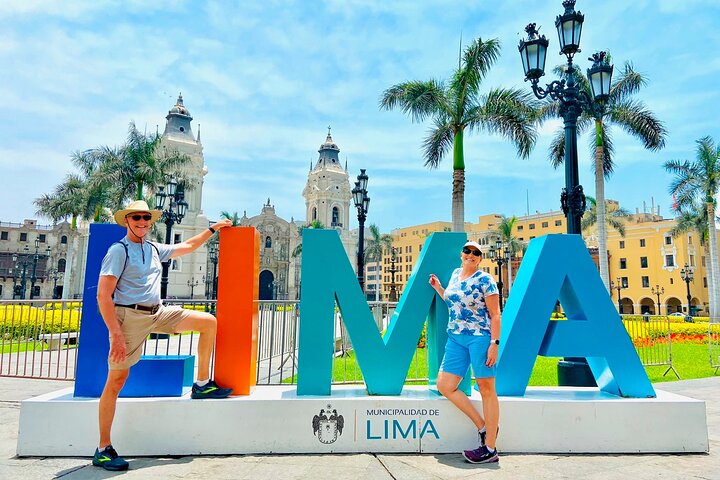
The expedition begins in Lima, where arrival at the international airport is followed by a transfer to the Miraflores district. This neighborhood is perched on cliffs overlooking the Pacific, and the air carries the scent of salt. Time permitting, a walk along the cliff-top promenade, the malecón, offers views of the ocean as the sun sets.
📍On the ground
Settle into your hotel in the Miraflores district.
The day's work is an examination of Peru's artistic chronology, beginning after breakfast at the JW Marriott Hotel with a 14-kilometre journey to the Museo Larco. Housed in an 18th-century viceregal mansion, the museum’s collection offers a 5,000-year survey of pre-Columbian cultures through their ceramics and artifacts. After lunch, the focus then shifts to the 20th century in the Barranco district, located 15 kilometres away, to visit Casa Taller Víctor Delfín. This is not a commercial gallery but the artist's home, workshop, and active studio space, offering a direct view into his working process. The day concludes with a dinner of foundational Peruvian dishes, featuring causa and the classic pisco sour as part of the evening meal.
📍On the ground
Private, curator-led tour of the Museo Larco.
Visit the private home and workshop of artist Vïctor Delfín.
A morning flight crosses the Andes, landing in Cusco, the historic capital of the Inca Empire. From the airport, the route proceeds overland, descending into the Sacred Valley of the Incas. The afternoon is dedicated to an ethnographic visit to the Ccaccaccollo community, a Quechua village known for its weaving cooperative. Here, a resident National Geographic Explorer provides context for the demonstration of traditional textile production. The process is observed from start to finish: hand-shearing alpaca wool, using native plants for dyes, and weaving intricate patterns on backstrap looms. This engagement offers insight into a living tradition that sustains both cultural heritage and the local economy.
📍On the ground
Flight from Lima to Cusco over the Andes.
Visit the Ccaccaccollo women's weaving cooperative.
Meet with a National Geographic Explorer for added context.
The route through the Sacred Valley begins with a 41-kilometre journey to Cuyo Chico to learn about traditional adobe ceramics and bake empanadas in outdoor adobe ovens. The journey continues 38 kilometres onward to the Pisac archaeological complex, where vast Inca terraces demonstrate sophisticated landscape engineering dating to the mid-15th century. A farm-to-table lunch at Hacienda Sarampampa highlights the central role of maize in Andean agriculture. The day concludes in Urubamba at the workshop of ceramicist Pablo Seminario, whose contemporary pieces reinterpret pre-Columbian iconography to offer a tangible link between ancient aesthetics and modern artistic practice.
📍On the ground
Visit Cuyo Chico to learn about adobe ceramics and bake empanadas.
Explore the workshop of ceramicist Pablo Seminario.
The morning is dedicated to Ollantaytambo, a major Inca royal estate and one of the few settlements that retains its original urban plan and water channels. After spending one to one and a half hours exploring the ruins of the fortress complex, the journey continues via a scenic train that follows the Urubamba River downstream. This route marks a dramatic ecological transition, as the high-altitude Andean landscape gives way to the dense vegetation of the cloud forest. Upon arrival in Aguas Calientes, the base for visiting Machu Picchu, the day concludes with an overnight stay at Inkaterra Machu Picchu Pueblo.
📍On the ground
Guided visit of the Ollantaytambo ruins (1.0-1.5h) before the train to Aguas Calientes.
Scenic train journey along the Urubamba River to Aguas Calientes.
Where you stay: Inkaterra Machu Picchu Pueblo.
Day6
Machu Picchu
The Citadel of Machu Picchu
Day 6 of 9
An early ascent by road leads to the entrance of Machu Picchu, timed to witness the morning light reveal the site's iconic profile of stone structures and terraced hillsides. A guided exploration navigates the citadel's key sectors—the agricultural terraces, urban areas, and religious precincts—while examining the fine Inca masonry. The discussion touches upon the site's 1911 expedition led by Hiram Bingham, which was supported by the National Geographic Society, and the ongoing scholarly debates about its original function within the Inca empire. After a thorough visit, the route returns to Aguas Calientes for lunch before the train journey back along the Urubamba River to a lodge in the Sacred Valley.
📍On the ground
Early morning bus ascent to the citadel.
Learn about the National Geographic-supported 1911 expedition.
The route begins at the Maras salt pans, a hillside complex of thousands of terraced evaporative pools in use since pre-Inca times. A drive of 22 kilometres leads to the Moray archaeological site, situated at an elevation of 3,500 metres (11,483 feet). Here, concentric circular terraces sunk into the earth serve as a suspected Inca crop laboratory, designed to test agricultural viability at different altitudes. From Moray, a 42-kilometre journey through the Sacred Valley reaches Cusco, the historic capital of the Inca empire. An orientation walk through the historic center reveals the city's unique urban fabric, where Spanish colonial architecture is built directly upon Inca foundations. The day concludes with dinner at Nuna Raymi, featuring a tasting of native potato varieties, before overnighting at the Belmond Monasterio.
📍On the ground
Visit the pre-Inca Maras salt pans.
Explore the Moray archaeological site, a suspected Inca crop laboratory, set at 3,500m (11,483 ft).
Orientation walk through the historic center of Cusco.
Dinner at Nuna Raymi featuring a native potato tasting.
Where you stay: Belmond Monasterio.
Day8
Cusco
Cusco's Sacred and Colonial Layers
Day 8 of 9
The day is a deep reading of Cusco's stratified history. The morning's survey includes the city's Cathedral, the Qorikancha or 'Temple of the Sun'—the Inca's most sacred shrine, later encased by a Dominican monastery—and the massive polygonal masonry of the Sacsaywamán fortress overlooking the city. A midday gourmet picnic is arranged at an exclusive site near the Temple of the Moon, a less-visited huaca, or sacred site, outside the main city. The expedition concludes with an evening visit to the Museum of Pre-Columbian Art. A private cocktail reception in the museum's courtyard, followed by a farewell dinner, provides a final opportunity to reflect on the region's deep artistic and cultural chronologies.
📍On the ground
Expert-led tour of Cusco, Sacsaywamán, and Qorikancha.
Exclusive gourmet picnic near the Temple of the Moon.
The itinerary concludes with a transfer to the Cusco airport for the return flight to Lima. For travelers with later international connections, a day-use room is available in Lima, providing a space to rest before the final leg of the journey home.
📍On the ground
Flight from Cusco to Lima.
A day-use room in Lima is provided for those with late departures.