Japan's Tokyo, Kyoto & Osaka — An Expert-Led Route
12-day itinerary
A 12-day route from Tokyo to Osaka examining Japan's modern-traditional dialectic, with access to a sumo stable, a maiko tea ceremony in Kyoto, and a community exchange in the historic castle town of Hagi.
This itinerary is structured for the traveler who has already engaged with Japan's cultural history—through its literature, art, or prior visits—and now seeks a deeper, more contextualized layer of access. The route's value lies not in simply visiting Tokyo, Kyoto, and Hiroshima, but in the specific introductions it provides: to a working sumo stable, to the nuanced world of a Kyoto tea house with a maiko, and to the community of Hagi, a former castle town whose preservation efforts are a case study in themselves.
🧭 Premium+ Expert-Led
Book Signature: Japan's Tokyo, Kyoto & Osaka by G Adventures.
From $12,999 USD · 12 days · max 22 travelers · Luxury hotels, private transport, select meals trip code AJTONSPrices in USD. Your local currency is shown on G Adventures.
Each leg of the journey mapped out — where the day takes you, what's actually on the ground, and things to consider when planning this tour.
Day 1 of 12
Tokyo
Arrival in Tokyo
Arrival into either Narita or Haneda airport marks the start of the expedition. An overland transfer leads into the city's dense urban core to a hotel in Shinjuku. The day is for acclimatization, allowing for an initial, unstructured exploration of the surrounding district or simply observing the metropolis from above as evening descends.
Been to Tokyo?Create an account
and share your photos with other travelers planning this trip.
Day at a glance
Arrival transfer from the airport to the hotel.
Accommodation: Hilton Tokyo.
DIY Reality Check: Arriving at either Narita or Haneda airport after a long-haul flight, you face an immediate logistical challenge: a 60- to 90-minute journey into Tokyo's dense core. From Narita, the direct Narita Express train takes about 80 minutes to Shinjuku, and all seats must be reserved in advance or at the airport counter. Other rail options like the Keisei Skyliner are faster but require at least one transfer to the JR Yamanote line at a busy hub like Nippori. From Haneda, the journey is shorter at 40-60 minutes but still involves choosing between a direct bus or navigating a train-to-subway transfer. All these options require purchasing the correct ticket and navigating to the right platform before culminating at Shinjuku Station, the world's busiest, which serves over 3.5 million passengers daily through a maze of over 200 exits. A pre-arranged arrival transfer sidesteps this entire chain of decisions and connections.
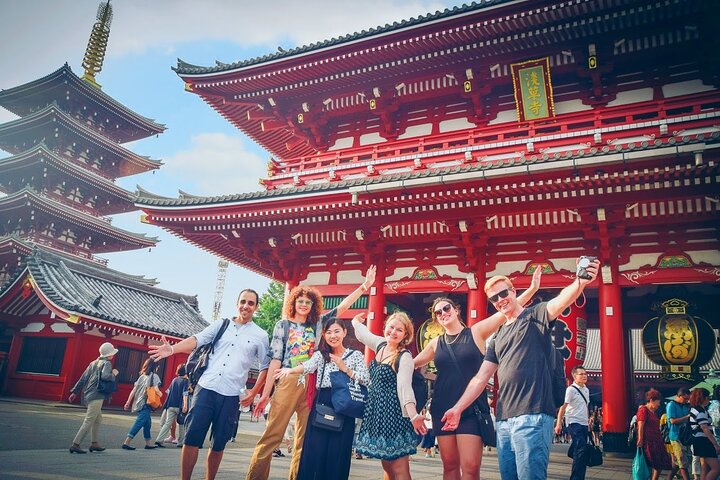
The day begins with an introductory lecture on Japanese history and culture from a resident specialist. The focus then shifts to the highly codified world of sumo, with rare access to a training stable to observe the morning practice session. This is not a public tournament but a direct observation of the wrestlers' discipline and power, followed by a shared meal of chanko-nabe, the high-protein stew that fuels their regimen. The afternoon provides a temporal contrast with a visit to the historic Asakusa district. Here, the main approach leads to Sensō-ji, a Buddhist temple founded in the 7th century, making it Tokyo's oldest. The path is lined with stalls along Nakamise-dori, a streetscape that retains a pre-war character.
Been to Tokyo?Create an account
and share your photos with other travelers planning this trip.
Day at a glance
Introductory lecture on Japan led by a local expert.
Observe a morning training session at a sumo stable.
Share a traditional chanko-nabe lunch with the wrestlers.
Guided walk through the Asakusa district and Sensō-ji Temple.
Accommodation: Hilton Tokyo.
Meals: Breakfast, Lunch, Dinner.
Day 3 of 12
Tokyo
Culinary Heritage and Urban Contrasts
The morning is dedicated to Tokyo's culinary infrastructure, beginning at the Tsukiji outer market. While the wholesale tuna auction has relocated, this sprawling market remains a vital center for fresh seafood, produce, and prepared foods, offering a deep look into Japanese foodways. A sushi lunch nearby provides an immediate taste of the market's quality. The afternoon is a study in the city's layered identity, moving from the market's Edo-period roots to the contemporary city. The itinerary cuts a path through the high-fashion district of Ginza, the famously dense Shibuya Crossing, and the tranquil grounds of the Meiji Shrine, a forested sanctuary dedicated to the deified spirits of Emperor Meiji and Empress Shōken.
Been to Tokyo?Create an account
and share your photos with other travelers planning this trip.
Day at a glance
Explore the stalls of the Tsukiji outer market.
Enjoy a fresh sushi lunch at a local restaurant.
Guided exploration of the Ginza and Shibuya districts.
Visit the serene Meiji Shrine.
Accommodation: Hilton Tokyo.
Meals: Breakfast, Lunch.
DIY Reality Check: Navigating the morning's culinary exploration at Tsukiji presents a challenge of scale; the outer market is a dense maze of approximately 460 shops, making it difficult for a visitor to distinguish premier vendors from the masses. This extends to lunch, where choosing from dozens of sushi counters can mean facing long queues at the most famous spots or settling for a gamble. The afternoon's logistics require stitching together a multi-part transit journey across Tokyo, moving from Tsukiji to Ginza, then onto the Tokyo Metro for Shibuya, and finally transferring to a JR train to reach Meiji Shrine. This culminates in a transfer at Shibuya Station, ranked by locals as one of the most complex in Tokyo due to its patchwork of operators, multiple levels, and decades of ongoing construction. A coordinated trip with a pre-vetted lunch and guided transit sidesteps this entire chain of overwhelming choices and complex navigation.